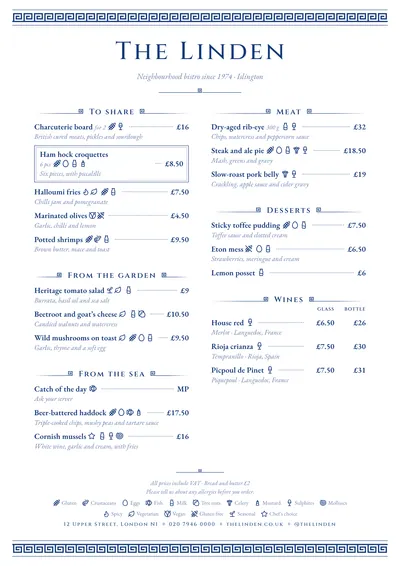
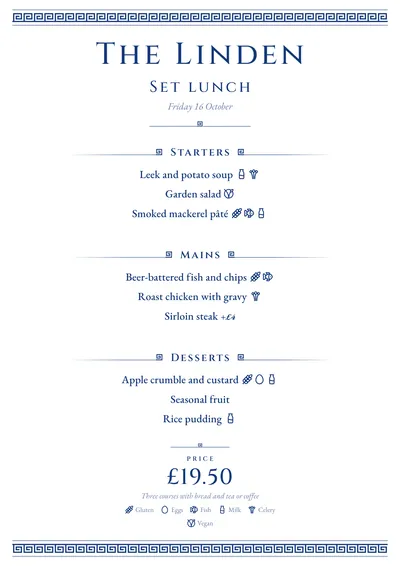
Greek key and capitals
Aegean opens and closes the page with a Greek key border, the meander from ancient Greek pottery, between two fine rules. Everything is printed in a single ink, Aegean blue, on white paper. The venue’s name is set in Cinzel, capitals inspired by classical inscriptions, with the subtitle in italics and a single key motif between two rules.
Each section heading is in spaced Cinzel, between two small key motifs with a rule running from them. Dishes are set in EB Garamond, a book serif, with the description in italics and dot leaders to the price. A featured dish is framed in a double-ruled box.
The menu it suits
Greek tavernas, Mediterranean and fish restaurants, and beach bars serving island food: mezze to share, grilled fish, salads, oven-baked stews and yoghurt with honey. Glass and bottle columns for wines line up under their headings.
It is a calm, classic style: the Greek key and the capitals provide the character, and the dishes area stays white and orderly. If your Mediterranean cooking is closer to Spain or Portugal, compare it with Azulejo.
Formats where it shines
- Two-column A4: the full menu, between its two borders.
- Slim A4 (140 × 297 mm): a slender single column for short menus.
- A5: the daily menu, centred.
- Booklet: with a cover in capitals and the Greek key at top and bottom.
For a seafood restaurant with more colour and a more nautical feel, look at Mariner.
Tips to get the most out of it
- Use the Greek names of dishes (moussaka, souvlaki, tzatziki) and explain in the description what goes into them.
- For mezze or sharing plates, create a section of their own and say in its note how many you recommend per person.
- In Aegean the ink and the accent are the same blue: if you change it, choose another dark colour so the border and the text stay readable.
- Dot leaders come built in: they lead the eye from dish to price on a two-column menu.
Colours, fonts, columns and format can all be changed in the editor without losing the design. It works on A4, US Letter, slim A4, A5, booklet, tri-fold, A3 and images for social media.
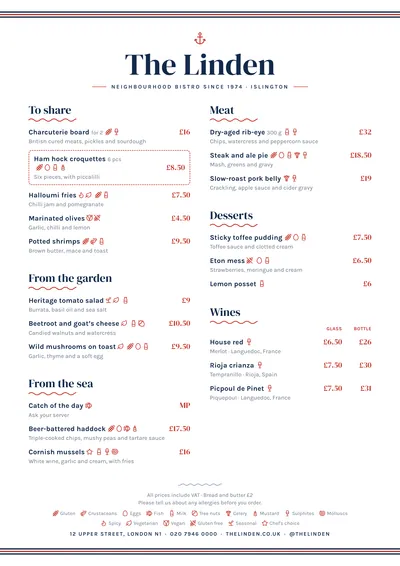 Mariner
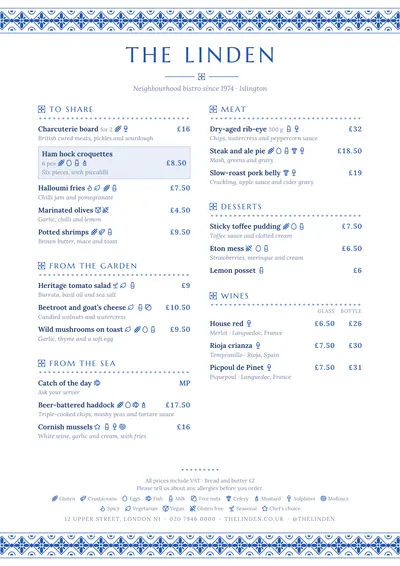 Azulejo
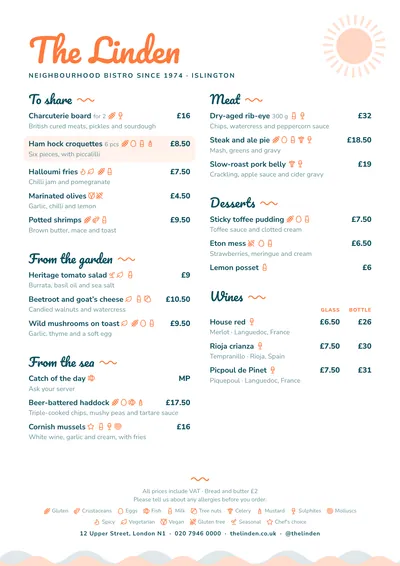 Beach Bar
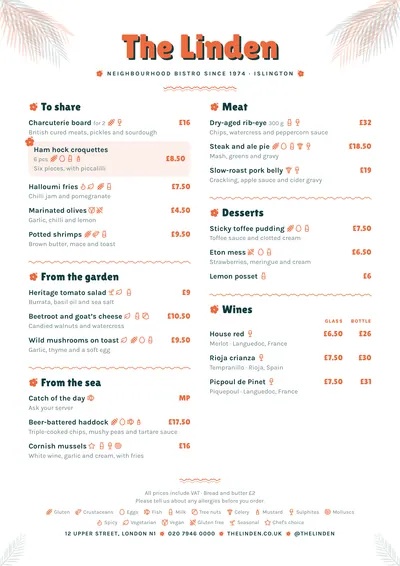 Tiki
Tiki