Tile borders
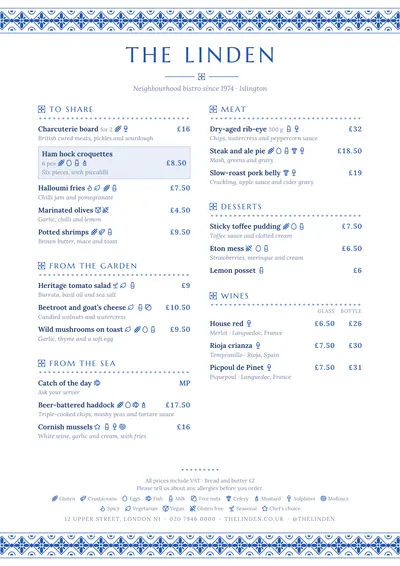
Azulejo opens and closes the page with a border of blue tiles, like the dado of an Andalusian courtyard or the front of a house in Lisbon. The venue’s name is set in Marcellus, classic Roman-inspired capitals, with a small tile between two rules beneath it and the subtitle in italics.
Each section starts with a tiny tile in front of a heading in capitals and a line of diamonds underneath. Dishes are set in Lora, a warm serif, with descriptions in italics and prices on the right. A featured dish sits on a very pale blue background.
The menu it suits
Paella and rice restaurants, Mediterranean cooking, Spanish or Portuguese restaurants and seaside places. It is a forgiving style for menus with rice dishes, fish, sharing starters and a wine list with glass and bottle prices, which line up under their headings.
Describe your rice dishes by what goes in them and how they are served: “Seafood paella, shells removed, in the pan”, “Black rice with aioli”. Shared conditions (per person, minimum two, waiting time) go once in the section note.
Formats where it shines
- Two-column A4: the full menu, between its two borders.
- Slim A4 (140 × 297 mm): one column for menus with lots of rice dishes.
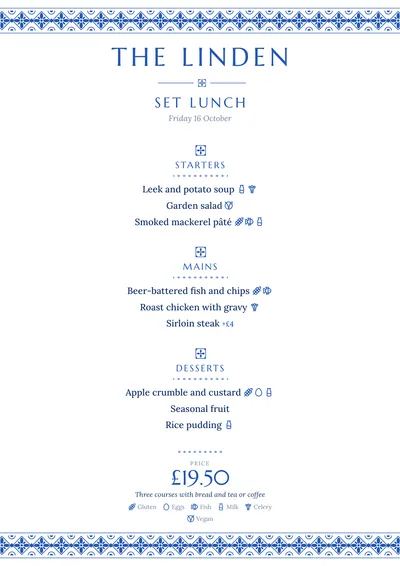
- A5: for the daily menu, with a tile above each course.
- Booklet: with a cover, for long menus.
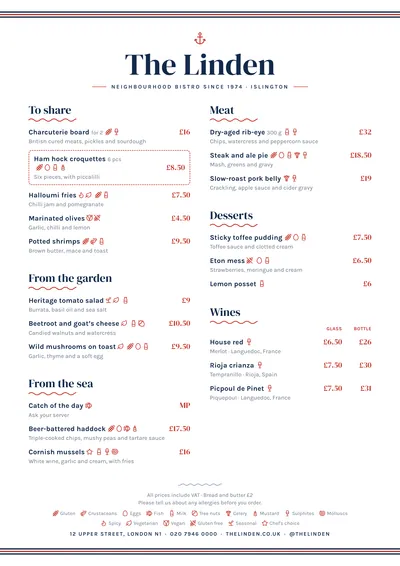
In blue it recalls Talavera or Lisbon; with another accent it moves to a different region. If your cooking is more harbour than courtyard, compare it with Mariner.
Tips to get the most out of it
- The borders follow the accent colour: in green, ochre or burgundy the style takes on a completely different character.
- If your rice dishes are priced per person with a minimum of two, say so in the section note rather than on every dish.
- With a long list of rice dishes, try slim A4: a single column keeps them in better order.
- The borders are thin and use hardly any ink; print on ordinary white paper.
Colours, fonts, columns and format can all be changed in the editor without losing the design. It works on A4, US Letter, slim A4, A5, booklet, tri-fold, A3 and images for social media.
 Mariner
 Feria
Feria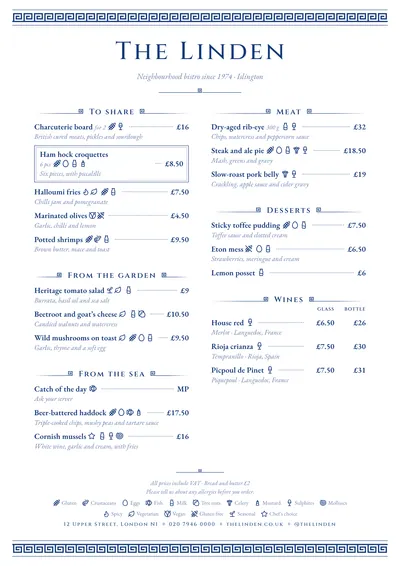 Aegean